AN OBSERVATION OF LIFE'S OVERLAPS

Saturday, July 24, 2010

Beijing Buddy

Before coming to China, I had so many theories (and misconceptions) of what Beijing would be like. As a child I had come with my uncle and cousin for a tour of the Summer Palace, The Forbidden City, and various other notable spots I'm sure.  I remember the city being cold, dirty, and sterile. Well, the first two  still apply, but having ditched the hotel rooms and tour bus I uncovered a city teeming with history and nationalism yet relentlessly modernizing.  I believe that it is possible to modernize without westernize and that China is developing its own renaissance so to speak. The first signs can be seen in contemporary art and architecture.  Thanks to a Beijing buddy I was able to get a more intimate slice of the city. This post will be about art and night life from a more localized perspective I hope.

The 798 Art District used to house many industrial factories before it was transformed in to a neighborhood of galleries, artisan shops, and restaurants.


A European bust of a man is covered with a Chinese, ceramic, floral pattern.


A cartoonish stainless steel sculpture by Xia Hang entitled It's Not Far features a funny little creature with propellers on his back.

 A stainless steel version of historical literary icon, Lao Zi by artist Zheng Lu is perforated using passages from his own works.  Lao Zi therefore becomes transparent yet still heavy.


String art decorates a tree outside a clothing shop.
 

An Art Noveau style defines an entrance to a  Spanish gallery...

while a more simple, rustic approach transforms a log in to steps for a shop.

Travel a little south to the Sanlitun neighborhood and you will find an awesome example of architecture as art. Opposite House by Japanese architect, Kengo Kuma is probably one of the most beautiful (interior) places I have ever seen in my life. This may be in part due to the uber expensive 98-room hotel also functioning as a rotating gallery space for artists.  Not to mention, the staff materialize out of thin air due to cleverly concealed doors and work stations.  I am beyond words, only that the Japanese really do aim for perfection.


Sanlitun, is also a popular night spot where a mixture of established clubs and dive bars converge in on each other.

My Beijing buddy is Sohith, a transplanted New York  designer in Beijing for the architect's playground that has become this city.  Although China holds great opportunity to build for the architecture industry, competition is fierce and the hours are way longer compared to the US.  How do you balance this? You go out even more to equalize work time and play time.


It's pretty easy to get in to places around here; there were no annoying lines, pretentious bouncers, or closing times it seems. Below is a roof top bar at dawn.


 Maybe I should have tried something more authentic for street food, but by then again, I already had my fill of Chinese and was really craving something more Western. Thank goodness they didn't screw it up.


The whole area of Sanlitun is only several blocks in total of alleys and streets but already a paradox in itself of class and crass.

Wednesday, July 21, 2010

Have You Eaten Yet?

Chinese food is a way of life.  Although China is a country that is developing it's economic and political stability, the majority of the population is still agricultural and remembers a time when famine existed.  Food is a staple of livelihood and meals (outside of the big cities) are almost always communal.  Hence, a common greeting when meeting someone after "how are you" is..."have you eaten yet?"

Below are some dumplings that I made at Ms. Geng's, a local English teacher's home. She made everything from scratch, even the reed mat that the dumplings are to be steamed on.  In her town, domestic skills are still standard for most women in addition to career skills to be competitive.


Although there is a market for a lot of packaged food and drinks, food made from scratch is still very important. Below is the scene at TESCO, one of the large chain supermarkets from Britain.  I thought it had a street market vibe albeit being indoors.

Below fresh peanut and sesame oil is made on the spot for customers.


Noodles, fried bread, and pastries are also all made behind the counter at the store daily.

Finally my favorite are the little steamed buns filled with sweet bean paste in the shapes of white peaches, pigs, and maybe a bear. 


Saturday, July 17, 2010

Great Wall Beach Party


So in a recent post I talked about visiting Laolongtao or Old Dragon's Head with the other foreign teachers to see where the Great Wall begins.  Little did I know that the other side of the wall hosts a rave every year.  They even have a website that you can visit here.  I was skeptical about going at first because I'm not much of a raver and the gate closes by 10:30pm at my school so that means I have to climb over the dusty wall in the dark.  However,  I went with another foreign teacher Adam, from Hebei Normal University and his buddies Farkas (I thought he said F*$kers when he introduced himself) and Lucas.


 The party was actually fairly tame but it was nice to just be on the beach during a cool summer night.  You could rent a horse to ride around on the sand or watch the World Cup quarter finals between Argentina and Germany.  You couldn't go in the water though because they roped it off for people(men) to pee in. Yeah.

Please Stand By---and We're Back!

I know this post is a little after the fact, but thanks for standing by while I experienced technical difficulties after canceling my VPN service in preparation to return to the US.  Anyways,  Common Ground is back on line and I would like to finish recounting this chapter on China so for those of you that I don't see often, please stay tuned.

Saturday, June 19, 2010

Reunions and Rehabilitated Residences

A primary reason for visiting Qingdao was to reunite with fellow foreign teachers who were placed on Huangdao, a city 30 minutes away by ferry.  The first night of the visit we stayed at a hostel called the YHA Old Observatory because it used be an observatory.  It's set on a hill top and has an amazing view of the city not to mention unlimited beer and free barbecue on weekends.  Some of the old astronomy equipment is still there so on clear nights you can gaze up in to the sky.

 Image courtesy of GraemeNicol via Flickr
I really appreciate the city's rehabilitation of historically significant buildings for use.  They do a good job of it. The next hostel we stayed at was Kaiyue Hostel closer to downtown.  It used to be an old church.  This was my favorite of the two. Check out more pictures on their website here.


 Image courtesy of Beijing07.wordpress.com


The private rooms are retro-fitted with pre-fab bathrooms that are kinda cool.

Here is an example of one of the private rooms.  We stayed in the triple.

Image courtesy of Kaiyue Hostel

 Image courtesy of Kaiyue Hostel

Staying at a hostel in China is surprisingly comfortable and affordable. They are a growing lodging trend  so many are newly renovated compared to low-budget hotels.  Also, the staff is usually competent in English and you will meet other traveling foreigners instead of Chinese tour groups. However, I would still recommend paying a little extra for the bathrooms ensuite.

The next evening we took the ferry across the bay to Shandong University on Huangdao for one last dinner. One thing that's great about eating with a lot of people is that you can order a lot of food.  The Shandong cuisine is mild in flavor and not too spicy with a focus on seafood.


From left to right: Lizzy, Jamie, Seth, Luke, Ryan, Jesse, Me, and Jim.


Friday, June 18, 2010

Qingdao: A Thirsty City


One tell-tale sign of culture is what the people eat, or in Qingdao's case--what people drink.   Although Qingdao's economy is it's beer industry, there is also wine street and coffee and tea art street.    I wasn't too surprised to see wine street, as China's wine consumption has risen dramatically over the past decade along with its westernization but my beloved coffee is still an emerging market.  Most cities will still practice the 2 hour siesta lunch break during the day so a jump start of caffeine is not always necessary.

Image courtesy of ilombardo via travelpod
Image courtesy of echinacities.com
I love Qingdao already but if it becomes a pioneer of the coffee market as well, I think I may have to stake out a summer home one day in this beach town, but I digress. We didn't have time to do coffee and tea art or wine street.


The heart of Qingdao is it's beer industry which was established by the Germans with the completion of a brewery.


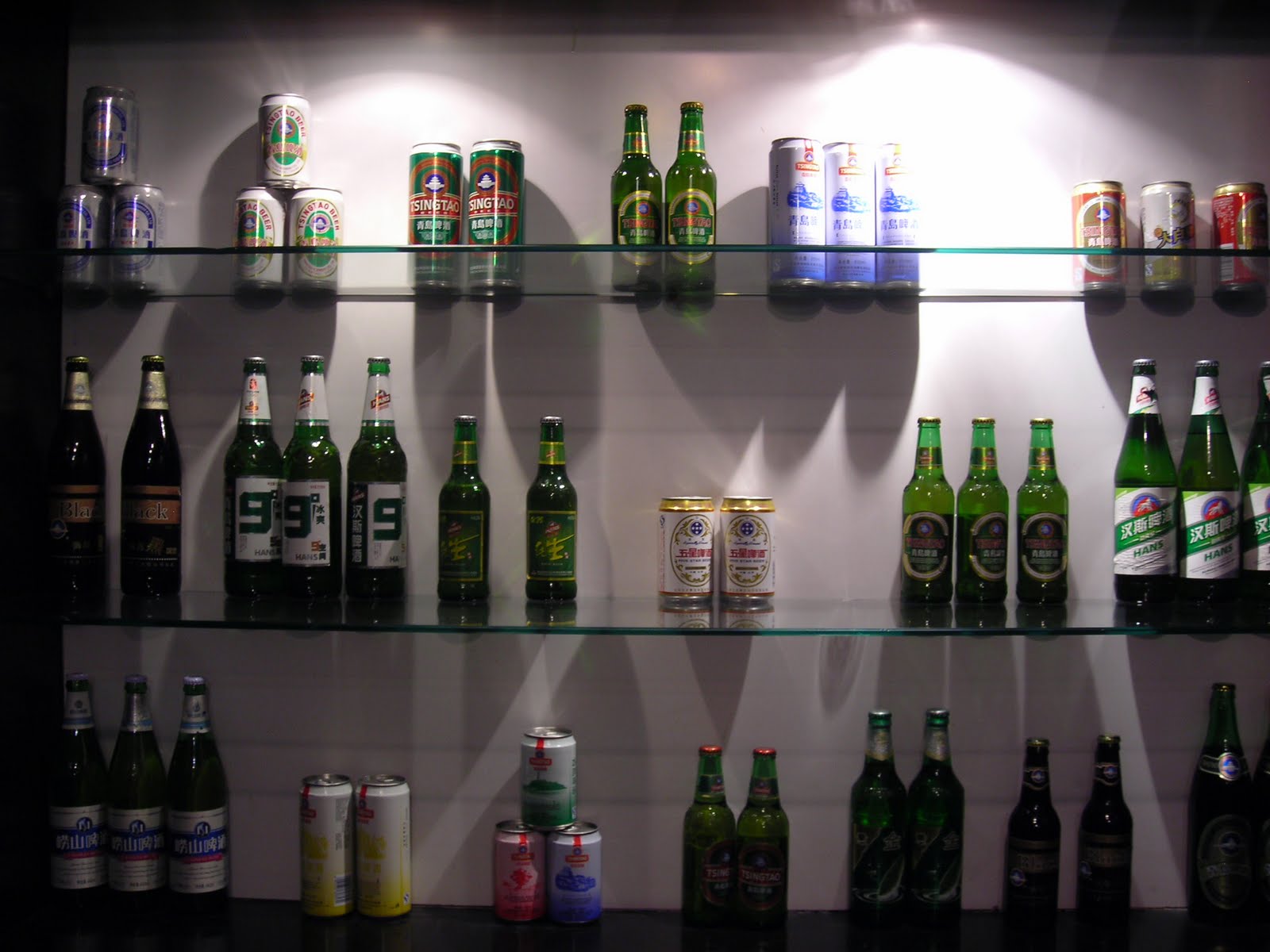
The Chinese have taken great pride in their Tsingtao. Below are some of the many varieties available including the Black stout and limited edition Olympic cans with cartoons that make it look slightly more like soda for kids than beer.


The new brewery is built right next to the old brewery which is now a museum.


 One of the exhibits is the "drunken house" which is definitely more than just a slanted room.  My theory is that it must sway ever so slightly because I felt a fool in that place.

 Overall, the brewery/museum is pretty interesting and well laid out though it doesn't top the Guinness Storehouse Brewery in design and free beer. You get two 4  oz. samples of Tsingtao draft and Tsingtao unfiltered plus a pack of Chinese-style, sweet beer nuts.  The best part of the museum is the final beer hall where you can watch awkward tour groups get wasted.  To the side their is also a booth where you can personalize your own beer bottle with your picture. The Chinese are so vain--especially when it comes to wedding pictures and glamor shots.


If you've read my earlier posts, you might notice that I have a penchant for taking pictures of sewer caps.  This is because every sewer cap in each city is unique and personalized for that city.  According to my mother, sewer caps are sometimes stolen and sold as scrap metal.  If there is a name on the sewer cap, it makes it harder to hock on the black market. 

The Qingdao sewer cap for Beer Street outside of the brewery is so cute!  However, I worry that this might target children in its advertisement of beer.


Qingdao is also really good for seafood. Along Beer Street restaurants will have their catches of the day displayed right when you walk in so you can take your pick.  There's nothing like fresh seafood with beer on a hot summer day.


We continued our appreciation of Qingdao's beverages on the beach where they sell beer by the liter. This is No. 1 Bathing Beach, one of the prettiest beaches along the coast.


Yes, it was a good day and my thirst for travel has been sufficiently quenched for the moment.